

18 Sept 2026 · 9 min read · Amello
How to Increase Restaurant Sales: 10 Strategies That Actually Work
Increasing restaurant sales sounds simple "Get more customers."
But that is only one part of the equation.
A restaurant can grow revenue by attracting more people, increasing how much each customer spends, getting existing customers to return more often, improving menu performance, or simply becoming easier to discover when someone is ready to eat.
The problem is that restaurant owners are often surrounded by advice.
Run more ads.
Post more reels.
Give discounts.
Add another delivery platform.
Launch a loyalty program.
Some of these tactics can work. But none of them should be the starting point.
The better question is:
Where is your restaurant currently losing potential sales?
Once you know that, growth becomes much easier to approach.
Here are 10 practical strategies that can help increase restaurant sales without turning every week into another discount campaign.
1. Understand Why Your Sales Are Changing
Before trying to increase sales, understand what is already happening inside the business.
Looking only at total revenue can hide important changes.
Imagine your restaurant made ₹5 lakh this month and ₹5 lakh last month.
At first glance, nothing changed.
But underneath that number:
Dine-in sales may have increased.
Delivery orders may have fallen.
Your average order value may have dropped.
A high-margin dish may have stopped selling.
Weekend revenue may be carrying weak weekdays.
New customers may be increasing while repeat customers are falling.
Those are completely different situations, even though total revenue looks identical.
Start by regularly looking at:
Total sales
Number of orders
Average order value
Sales by channel
Sales by day and hour
Item-level sales
New versus repeat customers
Outlet-level performance
The goal isn't to collect more numbers.
It is to understand what changed, why it changed, and what you should do about it.
2. Increase Your Average Order Value
Getting more customers usually requires additional marketing spend.
Increasing what existing customers spend can sometimes be much easier.
Suppose your restaurant handles 150 orders per day with an average order value of ₹600.
That creates ₹90,000 in daily sales.
If you increase the average order value from ₹600 to ₹650, the same 150 orders generate ₹97,500.
That's an additional ₹7,500 in revenue without acquiring a single extra customer.
The important part is how you increase that bill value.
Instead of aggressively upselling, create combinations that naturally improve the customer's meal.
A customer ordering pasta might reasonably be offered garlic bread or a beverage. Someone ordering a large family meal might appreciate a dessert bundle.
Useful tactics include:
Relevant add-ons
Meal combinations
Family bundles
Premium variants
Side dishes
Desserts and beverages
Minimum-order benefits
The best upsell feels like a recommendation, not a sales pitch.
3. Identify Which Menu Items Deserve More Attention
Not every item on your menu contributes equally to your business.
Some dishes sell frequently and generate healthy margins.
Some sell frequently but contribute very little profit.
Others may have excellent margins but barely get ordered.
And some simply occupy menu space.
This is where menu engineering becomes useful.
Instead of asking only:
Ask: “Which dishes are popular, profitable, and growing?”
Look at each item's:
Number of orders
Revenue
Contribution margin
Recent sales trend
Time or day when it performs best
Relationship with other frequently ordered items
You may discover that a dish sitting halfway down your menu generates better margins than the item you promote most heavily.
That is an opportunity.
Give stronger items better placement, stronger photographs, clearer descriptions and more visibility in your campaigns.
At the same time, investigate items whose sales are falling.
The answer is not always to remove them. Sometimes they simply need better positioning, pricing or presentation.
4. Make Your Restaurant Easier to Find on Google
Before many customers choose where to eat, they search.
They might search for:
“Italian restaurant near me”
“Best family restaurant in Indore”
“Cafe open near me”
“Best biryani nearby”
At this point, the customer already has intent.
Your job is to make sure your restaurant can be discovered and looks convincing when it appears.
Start with your Google Business Profile.
Make sure it has:
Correct opening hours
Accurate location and contact information
The right restaurant categories
Your latest menu
Ordering or reservation links
High-quality food photographs
Interior and ambience photographs
Updated business information
Regular review responses
Then look at your website.
If your restaurant serves wood-fired pizza in South Delhi but your website barely mentions the cuisine or location, search engines have less context about when your restaurant should appear.
Restaurant SEO does not need to become complicated.
Start by making it extremely clear what you serve, where you are, and why someone should choose you.
5. Turn First-Time Customers Into Repeat Customers
A restaurant that constantly needs new customers to maintain sales has a difficult growth problem.
Your existing customers already know your food.
They already know your brand.
They have already made the decision to buy from you once.
The next opportunity is getting them to come back.
But customer retention shouldn't mean sending the same WhatsApp offer to everyone in your database.
Different customers need different reasons to return.
For example: A customer who ordered three times last month but hasn't returned for 30 days is very different from someone who visited once six months ago.
A high-value regular customer should not necessarily receive the same communication as a first-time visitor.
Useful customer segments might include:
New customers
Frequent customers
High-value customers
Customers who haven't returned recently
Customers who prefer specific dishes
Dine-in regulars
Delivery regulars
The more relevant the communication is, the less it feels like marketing spam.
6. Stop Using Discounts as Your Default Growth Strategy
Discounts can increase orders.
That doesn't automatically mean they increase profitable sales.
A poorly designed promotion can reduce margins, attract customers who only purchase during offers, and train regular customers to wait for the next discount.
Instead of starting with:
Start with: “What business problem are we trying to solve?”
For example:
If Tuesday afternoons are consistently slow, create an offer designed specifically to improve that period.
If customers frequently order one main dish but rarely add drinks or sides, create a relevant combination.
If first-time customers rarely return, build an offer around the second visit.
If an item has strong margins but weak discovery, bundle it with something customers already love.
The promotion now has a purpose.
Discounting should be a tool, not the strategy itself.
7. Improve the Way Customers Order
Sometimes sales are lost simply because ordering is harder than it needs to be.
A customer discovers your restaurant.
They visit your website. The menu takes too long to load. The ordering link is difficult to find. The menu contains poor photographs. Delivery information isn't clear. Checkout requires too many steps.
The customer leaves. Restaurants often focus heavily on generating traffic while ignoring what happens after the customer arrives.
Review your ordering journey from the customer's perspective.
Can they quickly:
Find you → Understand the menu → Choose → Order → Pay?
The fewer unnecessary steps between discovery and purchase, the better.
Pay particular attention to mobile.
A large portion of restaurant discovery happens while customers are already on their phones. The experience needs to work naturally on a small screen.
8. Use Social Media to Create Demand, Not Just Engagement
A restaurant can have thousands of followers and still struggle to generate orders.
Likes are useful signals.
They are not restaurant revenue.
Your social media should make people want to experience the restaurant.
Show what makes your business interesting.
That could include:
A signature dish being prepared
The chef behind a popular menu item
A new seasonal menu
Behind-the-scenes kitchen moments
Customer experiences
Restaurant ambience
Events
Staff stories
New launches
Genuine customer content
Think about the difference between these two posts:
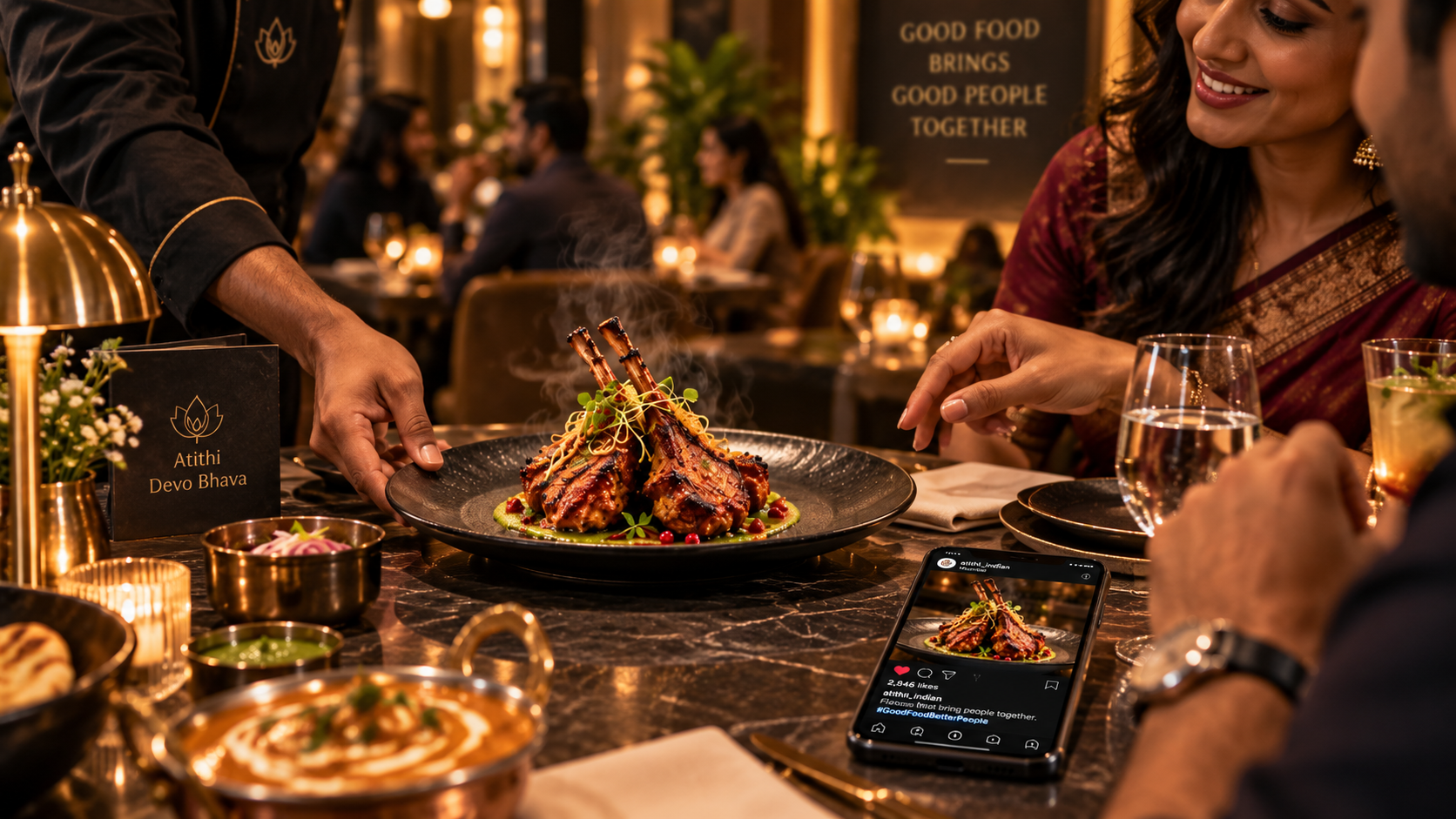
and a close-up video of a freshly prepared signature dish arriving at the table, followed by the story of how it is made.
The second creates desire before asking for a transaction.
Once someone becomes interested, make the next step obvious.
They should easily be able to find your menu, location, reservations or ordering link.
9. Treat Reviews as a Growth Channel
Reviews aren't just about reputation.
They influence whether someone who has never visited your restaurant feels confident enough to choose it.
A restaurant with recent photographs, thoughtful review responses and consistent customer feedback feels active.
A profile with outdated information and unanswered complaints creates uncertainty.
Build review collection naturally into the customer experience.
You might use:
A QR code on the bill
A post-visit WhatsApp message
A link after an online order
A polite request from staff after a positive experience
But don't stop at collecting reviews.
Read them. If several customers mention slow service, that isn't merely a reputation-management issue. It may be an operations issue. If people repeatedly praise one particular dish, that's a marketing opportunity. If guests regularly mention the ambience, maybe that deserves more visibility in your content.
Your reviews contain customer research that people are voluntarily giving you. Use it.
10. Build a Weekly Restaurant Growth Routine
Most restaurants don't lack data. They lack a system for deciding what deserves attention. Sales sit in the POS. Customer information sits somewhere else. Reviews sit on Google. Instagram has its own insights. Advertising platforms have another dashboard. Delivery marketplaces have another. The result is usually more dashboards and less clarity. Instead, establish a simple weekly growth routine. Every week, answer four questions:
What Changed?
Did sales, orders, customer behaviour, menu performance, reviews or visibility move significantly?
Why Did It Change?
Look for possible causes such as seasonality, promotions, menu changes, customer behaviour, competition or operational issues.
What Matters Most?
Not every change requires action. Identify the few issues or opportunities that could meaningfully affect the business.
What Are We Doing Next?
Turn those insights into specific actions.
Not: “Improve Google.”
But: “Upload updated menu photographs and fix our missing Google menu link by Friday.”
Not: “Increase repeat customers.”
Specific actions get executed. Vague goals stay on dashboards.
Increasing Restaurant Sales Comes Down to Four Things
Most restaurant growth strategies eventually influence one of four areas.
Get Discovered
More relevant customers need to find your restaurant through search, Google, social media, recommendations and local discovery.
Convert
Once they discover you, your menu, reputation, website, ordering experience and positioning need to persuade them to choose you.
Increase Customer Value
Improve average order value and menu performance without damaging the customer experience.
Bring Customers Back
Turn more first-time customers into regular customers through strong experiences and relevant communication.
You don't necessarily need to improve all four at once.
You need to understand which one is currently holding your restaurant back.
Don't Just Ask “How Do I Increase Sales?”
Ask better questions.
Which part of my business has the biggest untapped opportunity?
Why did sales change this week?
Which dishes should I push more?
Which customers are becoming inactive?
Where are competitors getting discovered but I am not?
Which action would have the biggest impact right now?
The answers will be different for every restaurant.
And that is precisely why copying someone else's marketing calendar rarely works.
From Restaurant Data to Restaurant Growth
Restaurant owners already have access to enormous amounts of information.
Orders.
Customers.
Menu items.
Google searches.
Reviews.
Social media.
Competitors.
Campaigns.
The difficult part isn't producing more data. It's connecting those signals and understanding what they mean. That's where Amello comes in. Amello helps restaurants bring their growth signals together, understand what is changing and identify what they should work on next. Instead of simply seeing that sales went down, the more useful question is:
Why did they go down — and what should you do about it?
Because another dashboard isn't the goal. Growing your restaurant is.
Frequently Asked Questions
How Can I Increase Restaurant Sales Quickly?
Start with areas that don't require acquiring significantly more customers. Look at average order value, menu performance, existing customer retention, ordering friction and underperforming time periods. These can reveal opportunities faster than launching an entirely new marketing channel.
How Can Restaurants Increase Sales Without Discounts?
Restaurants can improve local search visibility, increase average order value, optimize their menu, encourage repeat visits, improve reviews and make ordering easier. Discounts are only one of many ways to influence demand.
What Is the Best Way to Attract More Customers to a Restaurant?
There isn't one universal channel. Focus on where customers already discover restaurants in your market, including Google, social media, recommendations, delivery platforms and local search. Then make sure your restaurant looks compelling when they find it.
How Do Restaurants Increase Repeat Customers?
Delivering a good experience is the foundation. After that, identify different customer groups and communicate with them based on their behavior rather than sending the same promotion to everyone.
What Restaurant Metrics Should I Monitor?
At minimum, understand sales, order volume, average order value, item performance, channel performance and repeat customer behavior.
The most useful metric, however, depends on the specific problem you're trying to solve.
See what Amello finds for your restaurant.
Get a free AI growth audit of your listing, reviews and local search presence.
Find my Restaurant